Cards For Hyper Times
Slowly crafting a book is humbling, and courage is required. A process that deepens my respect for authors I admire who've clearly marinated and wrestled in gifting something worth sharing.
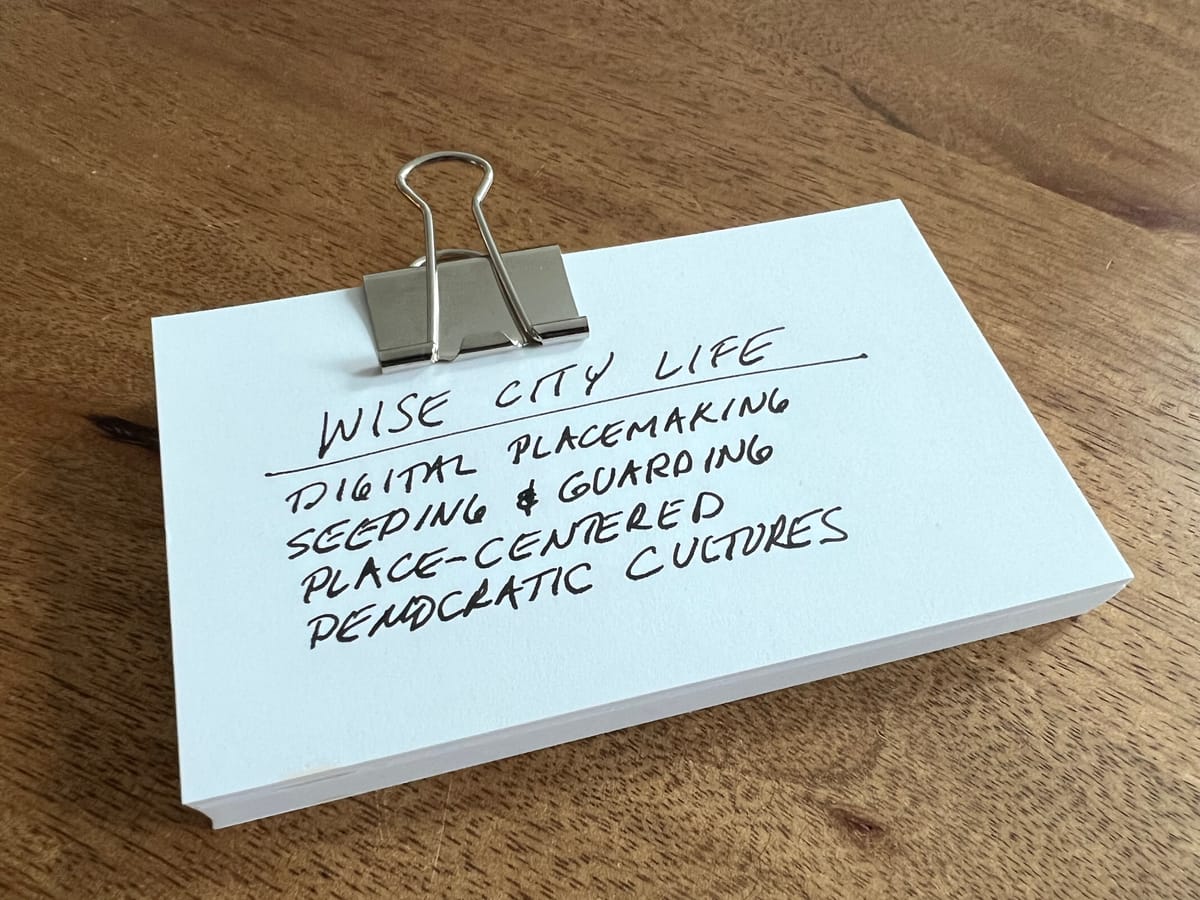
I'm in the outlining stage now, and the tool that's proving most valuable isn't any software. It's a stack of thick paper index cards held together with a spring steel binder clip.
Writers have organized books this way for generations. The practice goes by different names — the notecard method, carding, the Zettelkasten tradition — but the principle is the same: constrained physical cards you can hold, shuffle, spread across a table, and rearrange with your hands. Joan Didion worked this way. Twyla Tharp describes filling physical boxes for each creative project. Screenwriters card their scripts on corkboards before writing a word of dialogue. The method endures because it works at the speed of thought without the overhead of screens.
With my career steeped in R&D and innovation across many tech bubbles, I'm always testing technology at my own boundaries. Today's "AI" LLM automation is perhaps the shiniest form of distraction, with many dirty technical and ethical problems. Some may eventually be made cleanly, for intentional, specific, regulated use cases.*
The existential contrast is high these days. Perhaps that's why, for the real stuff of life — like reflection on our present age — I'm finding the prior technology of spring steel binders and thick paper index cards, with their forced concision, to be the most valuable.
New doesn't mean better. Most everything today is technology, everything mediates in life's interconnected reality.
Index cards are technology. A pen is technology. A large wood table is technology. The choices we make about which medium to think in shape the thinking itself — this is the core insight of media ecology, and it applies as much to a writer's desk as it does to a city's public spaces.
This is also what I mean when I talk about wise technology choices in cities and organizations. Digital placemaking isn't about digitizing everything. It's about discernment — knowing when a screen serves connection and when it interrupts it, when automation accelerates meaningful work and when it substitutes activity for depth. I try to live that discernment in my own practice, not just advise it.
Long ago, in the early 90s, Timothy Leary said the World Wide Web was the most psychedelic substance he'd ever tried and it's why he stopped using drugs. LLMs aren't the only place "hallucinations" happen. It might be that the majority of any screen-based digital experience — made with whatever intention — is largely a dirty, unmindful mix of mass hallucinations.
It's important to step back and out of this and reconnect.
"Touch grass", but also touch paper, pens, pencils, books, hands, parks, plazas, streets. Reconnect with how your body and mind are doing. Preferably with others seeking the same regrounding — feeling deeply that there are wiser ways that urgently need our focused attention.
The photo at the top of this post is my current outline, only half filled. Thick note cards in a spring steel binder clip, on a wood table. No screen in sight. And about 200 pages of raw, rough, undeveloped work in a digital notebook. Sometimes the wisest technology decision is a very intentional mix of old and new.
This is one dispatch from a book I'm slowly crafting about technology, wisdom, and the places where we live. If you'd like to follow the journey, subscribe. More to come as the work develops.
*Technical aside: regardless of context density, clear boundaries, or outcome-driven orchestration, it seems that anything LLM based is deeply flawed technically... they currently can't even maintain state about an accurate concept of time.